
• home
    • Voter Protection Hotline
    • How to Vote
    • Register to Vote
    • Registration Deadlines
    • Election Protection Info
    • Election Protection Forums
    • Legislation for Better Elections
  • film clips
  • watch full film
  • reforms
  • Broward County Ballot Destruction
  • blog
    • the film
    • the team
    • join us
    • contact
  • donate
Menu

Holler Back - [not] Voting in an American Town

  • home
  • votinginfo
    • Voter Protection Hotline
    • How to Vote
    • Register to Vote
    • Registration Deadlines
    • Election Protection Info
    • Election Protection Forums
    • Legislation for Better Elections
  • film clips
  • watch full film
  • reforms
  • Broward County Ballot Destruction
  • blog
  • about
    • the film
    • the team
    • join us
    • contact
  • donate
×

Troubling Questions Raised About Voting Machinery in Georgia Special Election

lulu July 3, 2017

The results from Georgia’s sixth district congressional race are odd.

Jon Ossoff, the Democratic newcomer who ran against Republican former Secretary of State Karen Handel, won the absentee vote 64% to 36%. That vote was conducted on paper ballots that were mailed in and scanned on optical scanners. Ossoff also won the early voting 51% to 49%. Those results closely mirror recent polls that had him ahead by 1-3 points. In the highest of those polls, he was ahead by 7% with 5% undecided and a 4% margin of error. 

On Election Day, Handel pulled out a whopping 16 percent lead, for a crushing 58% to 42% division of the day’s votes. That means that all 5% of the undecided voters broke for Handel, the poll was off by its farthest estimate and another 3.5% of Ossoff’s voters switched sides into her camp. All this despite Ossoff’s intensive door-to-door ground offensive that Garland Favorito, who lives in the heart of the sixth district called the "most massive operation” he’s ever seen. Favorito is the founder of VoterGA, a nonpartisan election reform group. He said Handel had signs up, but her canvassing operation didn't approach Ossoff's.

Michael McDonald, the political science professor who runs the United States Elections Project, expressed no surprise at the results, and seemed to indicate it was because of high Republican turnout. He tweeted a graph of early voting results, showing Republican turnout beating Democratic turnout by a ratio of 5 to 3. That is impressive turnout, but even with those numbers Ossoff won the early voting returns. So it would seem that many of the independents voted for him, and possibly some of the Republicans crossed over.

Unlike the absentee voters who filled out paper ballots, Election Day voters in Georgia used touchscreen machines that have no verifiable paper trail. These specific machines, the Accuvote TS, are susceptible to hacking, and in fact were hacked on national television in 2006 by computer scientists from Princeton. Professor Ed Felten also demonstrated the hack before Congress, testifying that their program could “silently transfer votes from one candidate to another,” and that “launching it requires access to a single voting machine for as little as one minute.”

Not only were the machines hacked 10 years ago, with no known patch put in place to protect them from that vulnerability, the entire Georgia election systems website was penetrated in August 2016 by security researcher Logan Lamb.

“It was on the wide-open internet,” Lamb said in a recent phone interview. Lamb was able to download passwords, instructions to election workers and databases used to prepare the ballots and tabulate votes. He easily downloaded all of this as part of 16 gigs of sensitive Georgia election data that was left completely unprotected on the internet for months. Asked what level of expertise was required, he replied, “little to none.”

Read More...
In Election Reform, Georgia Special Election, hand counted paper ballot Tags Georgia, Special Election, Ossoff, Handel, Elections, Hacking, Voting, electronic voting machines, hand-counted paper ballots
Comment
GA-spec-elex-lawsuit.jpeg

Georgia Lawsuit Tries to Stop Use of Touchscreen Machines in Special Election

lulu May 26, 2017

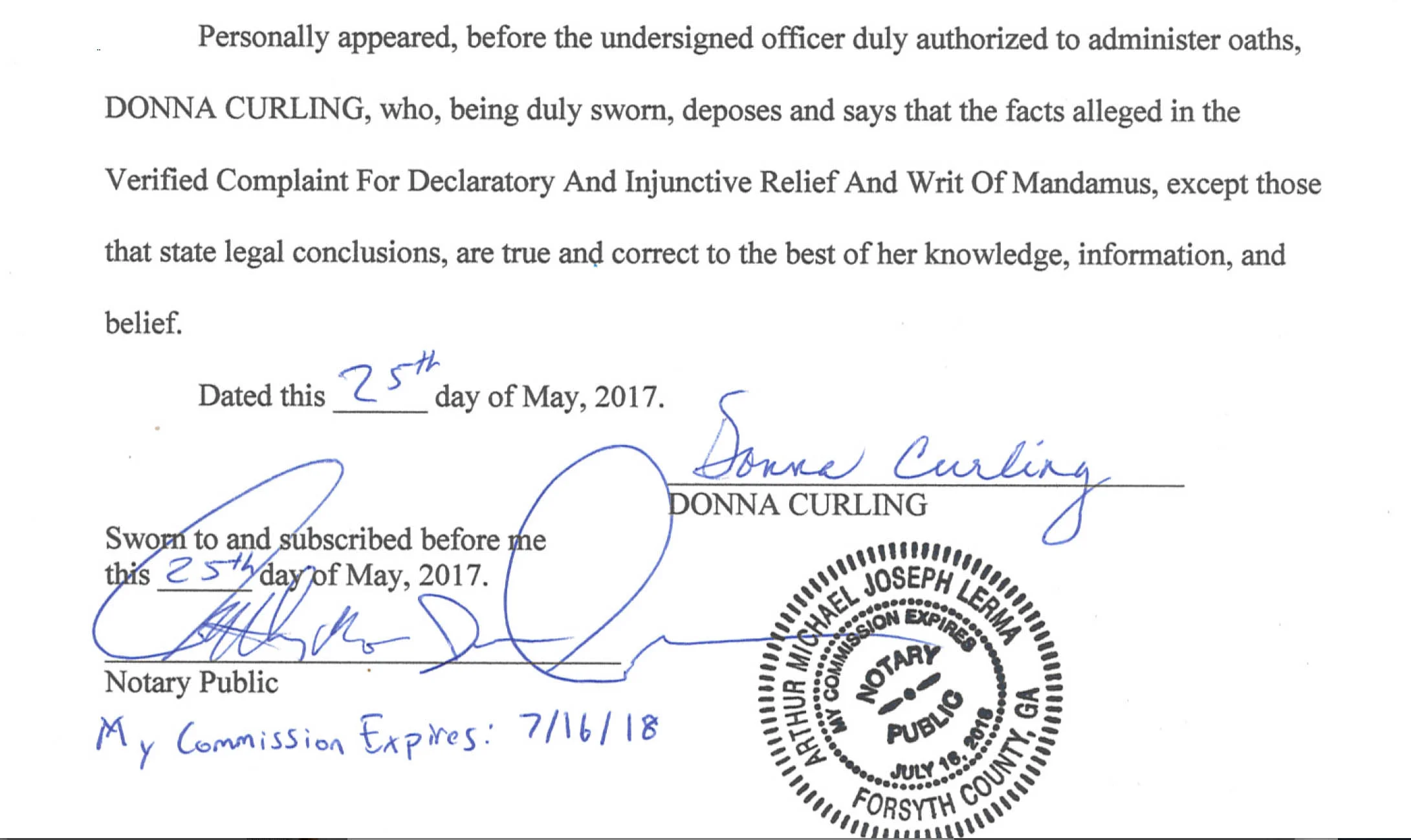
Yesterday two Georgia voters who are in leadership positions with Georgians for Verified Voting and an election reform non-profit filed a lawsuit against Georgia Secretary of State Brian Kemp and election directors of the three counties making up Georgia's 6th Congressional District. They are seeking a preliminary injunction against the use of touchscreen voting machines in the upcoming special election on June 20th. Early voting is scheduled to begin in 4 days on May 30th. They will be filing a motion for a temporary restraining order this morning. Marilyn Marks, Executive Director of the Rocky Mountain Foundation, the organization spearheading the lawsuit, said in a late-night phone interview that they were anticipating a hearing this afternoon.

Documents filed in the lawsuit claim that the machines have numerous safety and accuracy concerns including:

- A breach in the security of the Center for Election Systems that was investigated by the FBI

- An encryption key that was released onto the internet

- The Possibility of a corrupt database

- A demonstration model of the voting machine in use was hacked and infected with vote stealing software by a security team, and no evidence has been provided that the known security flaw was repaired.

- The inability of the system to identify the introduction of improper data

- Inadequate physical security for the machines

- The system not appearing to meet fundamental standards for federal certification

- The system being 15 years old and relying on a non-industrial strength database

- Two letters from sixteen prominent computer scientists expressing that they were, "profoundly concerned about the security of Georgia’s votes."

According to the suit, Georgia law requires that officials be able to demonstrate that voting machines can be safely and accurately used, and that if reexamination shows that not to be the case - then the approval of the system "shall immediately be revoked by the Secretary of State; and no such system shall thereafter ... be used in this state."

The suit further states that the remedy under Georgia law if the machines cannot be used is to use hand-counted paper ballots. Virginia Martin, an election official in Columbia County, New York, where paper ballots and hand counting are used, said, "I believe that Georgia could run its special election on paper ballots ... Despite the length of time involved, the benefit of having auditable paper records, given the election problems the state has recently experienced, should be very appealing ... For election boards that don’t currently conduct hand counts, this is an easy election to begin on. Counters could be recruited over the next weeks and trained. Unforeseen wrinkles in the process could be discovered during a mock count, which would show both recruits and staff what to expect. The ballot’s simplicity makes it perfect for a hand count, just like in recent European elections." 

In Election Reform, Hacking, hand counted paper ballot, Georgia Special Election Tags Geogia, special election, Hacking, hand-counted paper ballots, Jon Ossof, Karen Handel, Rocky Mountain Foundation, Marilyn Marks, Virginia Martin
2 Comments

Search Posts

Post Archive
  • Honest Elections
  • Election Reform
  • hand counted paper ballot
  • Hacking
  • 2016 Election
  • election recounts
  • Tim Canova
  • risk-limiting audits
  • Audits
  • Florida Elections
  • Georgia Special Election
  • Platform for #HonestElect
  • defcon
  • HAVA
  • Russiagate
  • Voter Registration Data